How many words do you actually need? The three numbers that matter
Fluency is not a number. Coverage is. Here are the three vocabulary sizes that change what you can do, what they feel like from the inside, and roughly how long each stretch takes.

- 2,000 word families — survival. You can get through a transaction. You cannot follow a conversation you are not part of.
- 5,000 — reading stops hurting. This is the one to aim at, and the stretch where most people quit.
- 8,000–9,000 — you read for pleasure and stop noticing you are doing it in another language.
- The number is not the goal. Coverage of the specific thing in front of you is.
“How many words do I need to be fluent?” is a slightly wrong question that every learner asks anyway, including me, repeatedly, usually late at night while procrastinating on actual studying.
It is wrong because fluency is a bundle of separate skills and vocabulary is only one. But there is a real, measurable thing hiding inside the question — coverage, the share of words you know on a given page — and coverage predicts almost perfectly whether you can read something without wanting to lie down.
The three thresholds
Decades of corpus work, most associated with Paul Nation and Norbert Schmitt, keep landing on the same three places.
What the gap between 95% and 98% actually feels like
Three percentage points sounds like a rounding error. It is not — it is the difference between an activity you look forward to and one you keep putting off. Here is the same paragraph at both levels, with the words you would not know blanked out.
La casa estaba al final de un camino estrecho que subía entre los árboles y terminaba en una puerta de madera pintada de azul que nadie había abierto en muchos años, según decían los vecinos del pueblo, aunque ninguno de ellos recordaba ya quién vivía allí antes. En verano la hierba crecía hasta las ventanas y en invierno el viento bajaba de la montaña y hacía sonar las contraventanas durante toda la noche. Los niños se acercaban en grupo hasta la verja, se quedaban un momento mirando hacia arriba, y después volvían corriendo hacia la plaza sin decir nada.
La casa estaba al final de un camino estrecho que subía entre los árboles y terminaba en una puerta de madera pintada de azul que nadie había abierto en muchos años, según decían los vecinos del pueblo, aunque ninguno de ellos recordaba ya quién vivía allí antes. En verano la hierba crecía hasta las ventanas y en invierno el viento bajaba de la montaña y hacía sonar las contraventanas durante toda la noche. Los niños se acercaban en grupo hasta la verja, se quedaban un momento mirando hacia arriba, y después volvían corriendo hacia la plaza sin decir nada.
95% coverage is where reading is possible. 98% is where it is enjoyable. Only one of those gets done on a Wednesday evening.
What “word family” means, and why it makes the numbers look small
A word family is a lemma plus its inflections and close derivations. Run, runs, running, ran, runner is one family, not five. Count surface forms instead and every number above roughly triples while telling you less.
This is also why cross-language comparisons get slippery. Spanish conjugation produces dozens of forms per verb; English produces four. Same family count, wildly different amount of stuff on the page.
Rough thresholds by language
A caveat I want to put above the table rather than below it, because tables get screenshotted: these are rules of thumb drawn from the reading-research literature, not measurements of you. Treat them as “roughly this neighbourhood”, and be suspicious of anyone quoting them to three significant figures.
| Language | Families for ~95% coverage | What skews it |
|---|---|---|
| Spanish | ~5,000 | Regular, transparent morphology. Forgiving to start. |
| English | ~5,000 | The Latinate/Germanic split means two words for everything. |
| German | ~5,500 | Compounds give leverage: know Haus and Tür and Haustür is free. |
| French / Portuguese / Italian | ~5,000–5,300 | Heavy cognate support if you already have English. |
| Polish / Russian | ~6,000–6,500 | Case systems and aspect pairs inflate the apparent count. |
| Mandarin | ~4,000 | Lower lemma count, but several thousand characters on top. |
| Japanese | ~5,500 | Plus roughly 2,000 kanji before reading gets comfortable. |
Where the curve bites
Those middle numbers are the honest part of this article. Going from nothing to 2,000 is exhilarating: every week you understand things you could not understand last week. Going from 2,000 to 5,000 takes about a year and feels, for long stretches, like nothing is happening at all.
It is not nothing. Coverage is a threshold effect, so most of the benefit arrives in a lump near the end of the stretch rather than smoothly along it. Knowing that in advance is most of what gets people through it.
I think chasing the total number is a trap, and I say that as someone who checks his own. The number is a lagging indicator of a habit. You cannot push it directly, and staring at it mostly produces the urge to bulk-add frequency lists — which inflates the count and teaches you very little, because a word you met on a list has no sentence attached to it and no reason to stick.
The number worth watching is coverage of the thing you actually want to read. Three thousand words chosen by your own reading will carry you through a novel that six thousand off a frequency list will not.
A roadmap that survives contact with reality
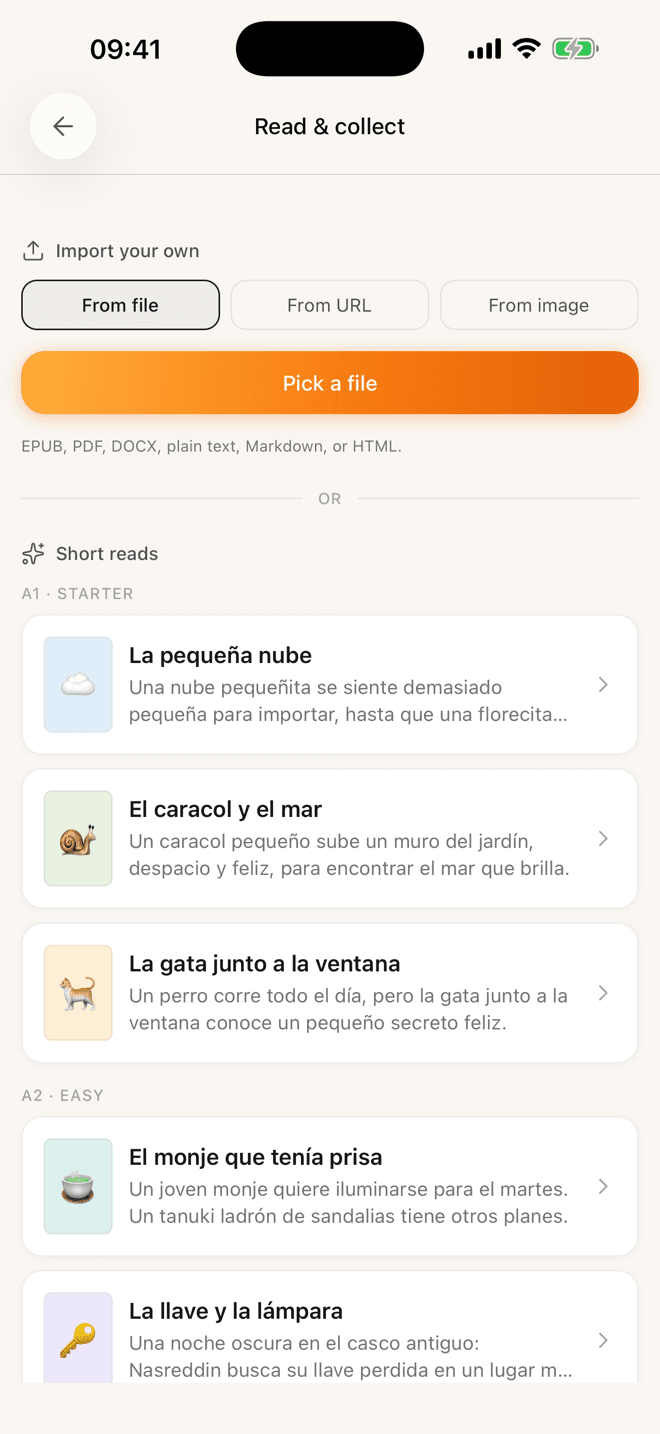
- 0 → 2,000. Frequency order genuinely is optimal here, because at this stage almost every common word is one you need. Graded readers at A1 and A2 do the same job with sentences attached, which I would take over a bare list every time.
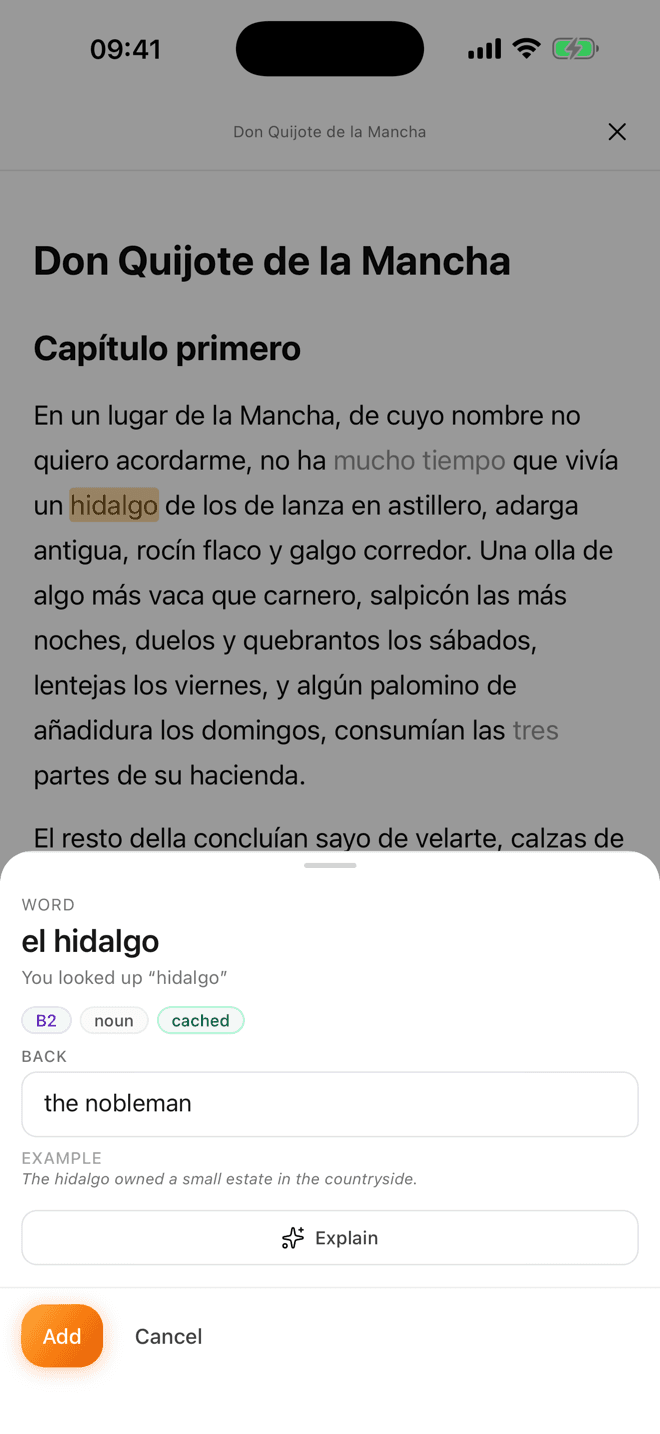
- 2,000 → 5,000. Switch. Stop working through lists and start mining things you chose. One short article a day and one chapter a week is a perfectly good year. The cards now come from your interests, which is what makes them stick.
- 5,000 → 8,000. Read whole books. Your yield per chapter collapses — you already know almost everything — but the handful of words you do catch are precisely the ones no course would ever have taught you.
- 8,000+. There is no plan. Read. Tap the occasional word. Five minutes of review. You are done with methodology.
How to read your own numbers
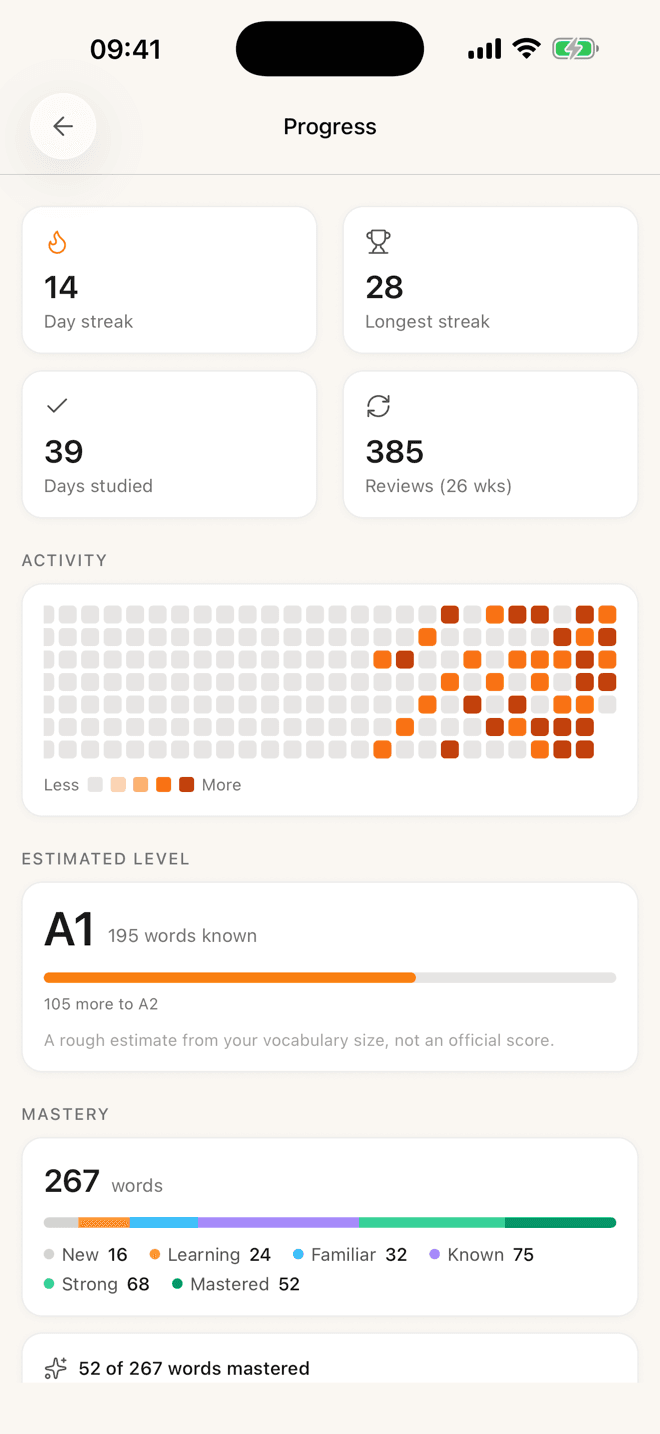
In Lemnly your words move through six states — New, Learning, Familiar, Known, Strong, Mastered — and the app converts the ones you genuinely know into an estimated CEFR level, with the gap to the next one spelled out (“105 more to A2”).
It says on the screen that this is a rough estimate rather than an official score, which I insisted on, because a number that looks authoritative and is not is worse than no number at all. Count the Known-and-above buckets when you compare yourself to the thresholds above. Counting everything in your deck, including the words you added yesterday, will flatter you by about 40%.
Questions people ask about this
- How many words do I need to be fluent?
- Fluency is not a word count, but the useful proxies are: about 5,000 word families to read comfortably, and 8,000 to 9,000 to read almost anything without strategy. Conversation needs far fewer words than reading — perhaps 3,000 well-chosen ones — because you control the topic.
- How many words a day should I learn?
- Ten to fifteen is sustainable indefinitely alongside a job. Twenty-five is a sprint. The cap is not how many you can absorb today but how many reviews you are willing to inherit in six months.
- Do cognates count?
- They count, and for an English speaker learning a Romance language they are a large free head start. Do not add them as cards — if you understood it the first time you saw it, it does not need scheduling.
- Why does my app say I know more words than I can use?
- Because recognising and producing are different skills with different memories. Most counters measure recognition. If the gap bothers you, study some cards in reverse; it is slower and it is where speaking comes from.
The one-line version
Aim at 5,000 families. Get there by reading things you chose and keeping the words you meet. Expect the middle year to feel flat, and keep going anyway — the payoff is a threshold, and thresholds arrive all at once.
On picking material at the right level while you climb, see how to choose a first book; on making the words stay, see the forgetting curve.