You finished Duolingo and still can’t read a newspaper. Here’s why
The owl takes you to roughly A2 and then runs out of road, and the gap it leaves is not made of grammar. It is made of volume. What that means in practice, and a first week that does something about it.
- Duolingo gets you to roughly A2 and a couple of thousand words of recognition vocabulary. A newspaper wants four times that.
- The gap is volume of real text, not more grammar exercises.
- Start below your level on purpose, then short real articles, then one book you actually want to finish.
- The step everyone skips: keeping the words. Looking a word up is not learning it.
There is a very specific, slightly deflating moment a lot of people hit. Eighteen months of daily lessons. A streak you are irrationally proud of. And you cannot read a newspaper — not a difficult one, any of them.
This is not a failure of effort and it is mostly not a failure of Duolingo either. It is the tool doing exactly what it was designed to do and then reaching the edge of what that design can reach.
What Duolingo is genuinely excellent at
Two things, and I do not want to be sniffy about either, because they are hard.
It gets people to show up daily, which is the single hardest problem in this entire field. And it takes an outright beginner to a rough A2 — basic sentence patterns, a couple of tenses, maybe two thousand words of recognition vocabulary — without ever asking them to make a decision.
That last part is the actual trick. Duolingo removes choice. There is always a next lesson and it is always the right size. Beginners need precisely that, and it is precisely what stops working next.
Where the road ends
The distance between A2 and B1 is not a grammar list. It is hours spent with real language, and real language has three properties an exercise-based app has to strip out in order to function.
- Words appear at their real frequencies. In a course each word arrives once, on purpose, at a sensible moment. In a novel a word you need shows up on page 3 and then not again until page 60. Coping with that is a separate skill and it is the one that matters.
- Sentences are as long as they need to be. Course sentences are trimmed to fit the exercise. Real ones have subordinate clauses, asides, and three things happening at once.
- Nothing is calibrated to you. Real text does not care what you know. Reading it means building a tolerance for not understanding everything — and that tolerance can only be built by doing it, uncomfortably, for a while.
Duolingo cannot give you any of these without ceasing to be Duolingo. So the next step is not a better course. It is a different activity.
The arithmetic nobody shows you
The target everyone quotes is 98% coverage — knowing enough of the words on a page to get through it without exhausting yourself. That is about one unknown word in fifty, or two a paragraph. Below that, reading becomes decoding, and decoding is unpleasant enough that you will stop doing it voluntarily.
So: you have roughly 2,000 words and you need roughly 8,000. You close that gap by reading. Which requires vocabulary. Which you get by reading.
That circle is not a paradox, it is just a starting-conditions problem — and it is why this stage defeats people who did nothing wrong.
Breaking the circle
You break it by not starting with the newspaper. In this order:
- 1Go below your level
Graded readers written at A1 and A2 with controlled vocabulary. They are not literature and it does not matter. The job is thousands of words at 98% coverage until reading becomes automatic instead of effortful.
- 2Short real things
News stories, blog posts, recipes, match reports. Four hundred words means a bad choice costs you four minutes instead of a fortnight, and the vocabulary is contemporary.
- 3One book you want to finish
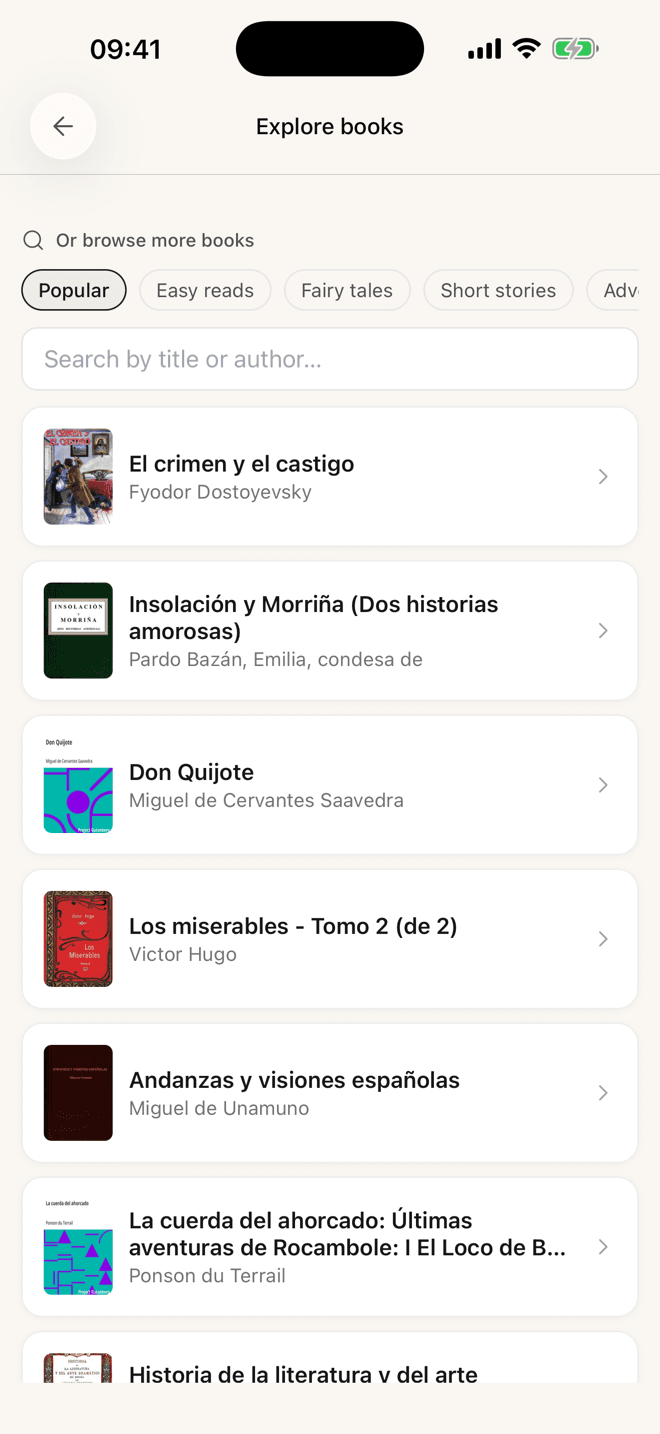
Not a book you think you should read. Motivation is the only thing that carries you through the rough first fifty pages, and a book you have already read in your own language is the classic cheat code.
There is more on choosing that book — including a two-minute test for whether it is too hard — in the piece on picking one.
The step almost everyone skips
Here is where reading plans quietly fail, and I speak as someone whose first one failed exactly this way.
You read an article. You look up eleven words. You understand the article. You feel good, and reasonably so. Two weeks later you meet the same eleven words and know none of them.
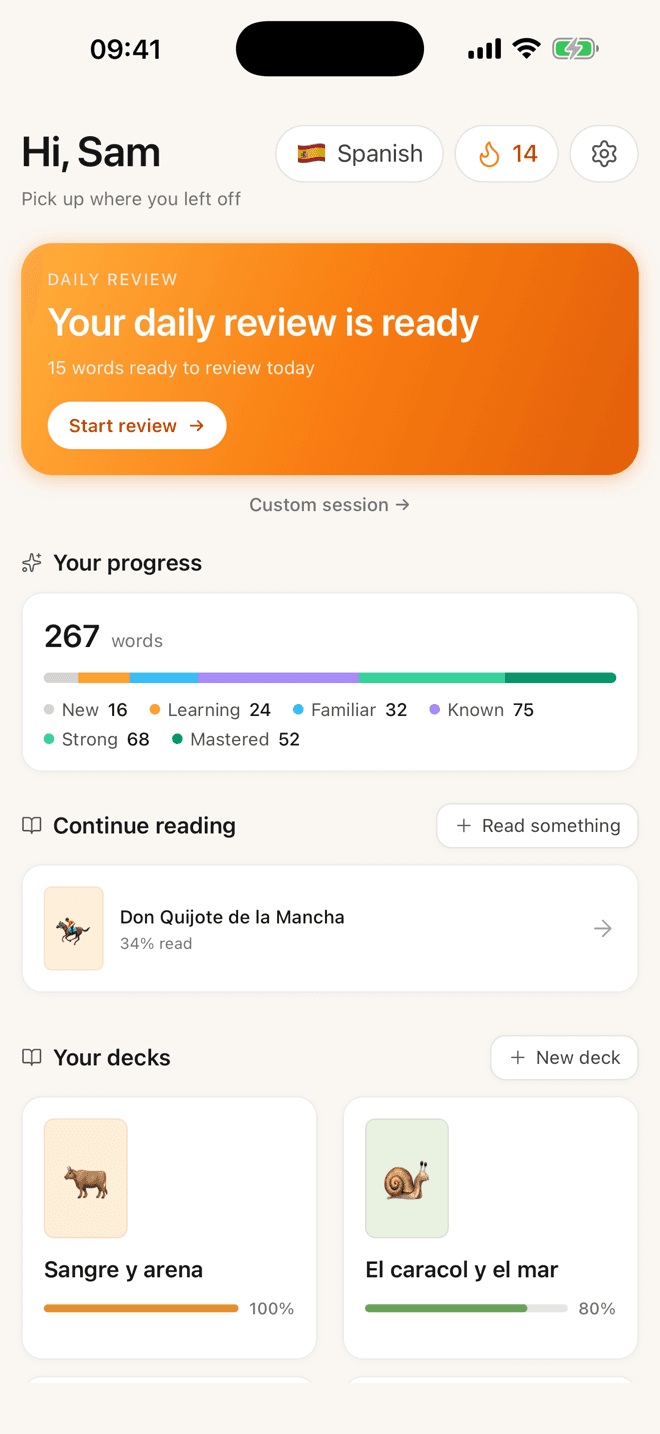
Looking a word up is not learning it. A single encounter leaves almost nothing durable; you need to meet it again around the point you were about to forget, several times, at widening intervals. That is the whole premise of spaced repetition and it is why the reading and the reviewing have to be joined up. If the book is in one hand and the flashcard app in the other, the join depends on your discipline at the exact moment you are enjoying a story and do not want to stop.
- Something at your level available without hunting for it.
- Looking a word up costs a tap, not a context switch.
- Words you looked up come back on their own, on a schedule.
- Twenty minutes most days, at a time that already exists in your life.
- A book two levels too hard, chosen because it is impressive.
- A dictionary in another app, or worse, another room.
- A vocabulary notebook you will absolutely review later.
- Three-hour Sunday sessions to make up for the week.
About the streak
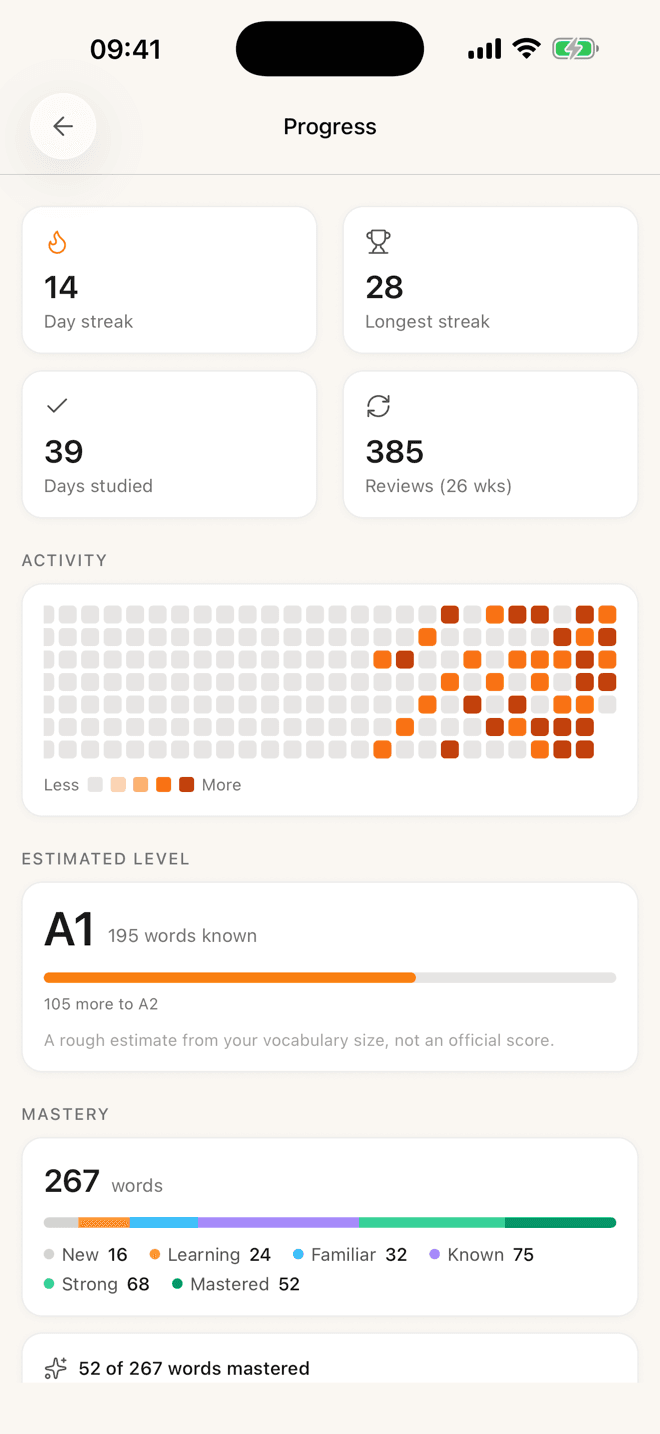
One more thing, because it is why people stall rather than switch. If you have spent a year being trained by a streak counter, stopping feels like loss. I have watched friends keep doing lessons they had visibly outgrown, purely to avoid a number resetting.
Worth naming what that number measures: whether you opened an app. Not whether you learned anything. Twenty minutes with a story you like moves you further than a flawless week of maintenance lessons, and it will not punish you for a missed Tuesday, because reading is something you do rather than a debt you service.
Keep the habit — it is the genuinely valuable thing Duolingo gave you, and it is not nothing. Just point it at something with more language in it.
The 2025 backlash was mostly aimed at the AI announcements, but I think the real fatigue underneath it is older and simpler: a lot of people gradually worked out that they had been very consistent for two years and could not have a conversation.
That is a brutal thing to discover, and the instinct is to conclude you are bad at languages. You are not. You were doing an activity that is excellent for the first six months and increasingly nutritionally thin after that, and nobody told you when to stop.
Questions people ask about this
- What level does finishing a Duolingo course actually get you to?
- Roughly A2, sometimes a weak B1 for the biggest courses. Strong on recognition, much weaker on production, and thin on listening to anything spoken at normal speed. That is not a criticism so much as a description of what an exercise app can do.
- Should I quit Duolingo entirely?
- Not necessarily, but stop treating it as the main event. Ten minutes of maintenance alongside twenty minutes of reading is a fine arrangement. What does not work is doing another year of lessons and expecting a different result.
- What should I do about my streak?
- Let it go, and notice how much that idea bothers you — that reaction is the product working as designed. A streak measures app opens, not learning. If you want a habit marker, count days you read something.
- How long until I can read a newspaper?
- From A2, expect something like a year of near-daily reading to be comfortable with mainstream news. You will be reading the easy sections — sport, culture — far sooner than that, which is why starting there matters.
- Is Duolingo bad?
- No. It is very good at the first six months and increasingly thin after that, and nobody tells you when to move on. The mistake is staying for year three, not starting.
A concrete first week
That is the whole transition, and it is much less structured than what you are used to. The discomfort of that is the point: from here the material is the world rather than a syllabus, and nobody is going to tell you what the next lesson is.
Lemnly is my attempt to put those pieces in one app — graded stories to start on, tap-to-translate that does not break the page, and the words coming back on an FSRS schedule. It is free, and deliberately has no leagues, hearts or streak-guilt. But the method matters far more than the tool. If you take one thing from this, take the reading.