Reading a news article in your target language, on your phone
Novels are a commitment. A news story is four hundred words and takes six minutes, which makes it the most underrated reading material at the intermediate stage. How to pick one you can actually finish, and what to do with the words.

- A bad article costs you four minutes. A bad novel costs you a fortnight and some self-esteem.
- Sport, food, culture and human-interest pieces are far easier than politics or economics. Start there.
- One article a day beats a novel you keep meaning to get back to.
- The words only count if something brings them back. Otherwise you are just having a nice time, which is fine but is not learning.
Everyone starts with a novel, and I understand why. A novel is a real goal. Finishing one in another language is a story you can tell at dinner. Nobody has ever said “I read a 400-word piece about a regional cheese festival in Spanish” and had the table go quiet with respect.
But at the intermediate stage the cheese festival is the better call, and I want to make the case properly.
The arithmetic of a bad choice
This is the whole argument. At the stage where you cannot yet reliably judge whether something is at your level, the thing that matters most is how cheap it is to be wrong.
And an article finishes. Nothing corrodes a reading habit like three half-read books sitting on a bedside table quietly reminding you that you are not the sort of person who finishes things.
Which articles are actually easier
Not all news is equally difficult, and the difference is much larger than people expect. Rough order, easiest first:
- Sport reports. Formulaic structure, concrete nouns, and you already know how football works.
- Food and travel. Physical vocabulary you can picture, which makes it stick.
- Human interest. A person, a problem, a resolution. The narrative carries you.
- Local news. Short, plain, and about things rather than ideas.
- Reviews of films you have seen. You already have the plot.
- Political analysis. Abstract nouns, subjunctives, and heavy assumed context.
- Economics. Every sentence has three abstractions stacked in it.
- Opinion columns by stylists. Wonderful prose, terrible input at B1.
- Anything satirical. Irony is the last thing you acquire in a language.
- Legal or medical reporting, unless that is your field.
If the first paragraph is about a person doing something, you are usually fine. If it is about a concept doing something to another concept, come back in six months.
Doing it on a phone, in six minutes
- 1Grab the link
From wherever you already read — a newsletter, a friend, a news site in your target language. Paste it into the reader rather than reading it in the browser.
- 2Read it once, fast
Tap words that block the sentence. Leave the ones you can infer. Do not stop to be thorough; thoroughness is the enemy here.
- 3Do nothing else
No summarising, no writing it up, no grammar notes. The words you tapped come back tomorrow on their own. That is the entire follow-up.
The reason to pull the article into a reader rather than reading it on the site is not purity, it is that news sites are hostile environments — cookie banners, autoplay video, a newsletter modal at the 30% scroll mark. Each one is a chance to lose the thread, and at intermediate level losing the thread means starting the paragraph again.
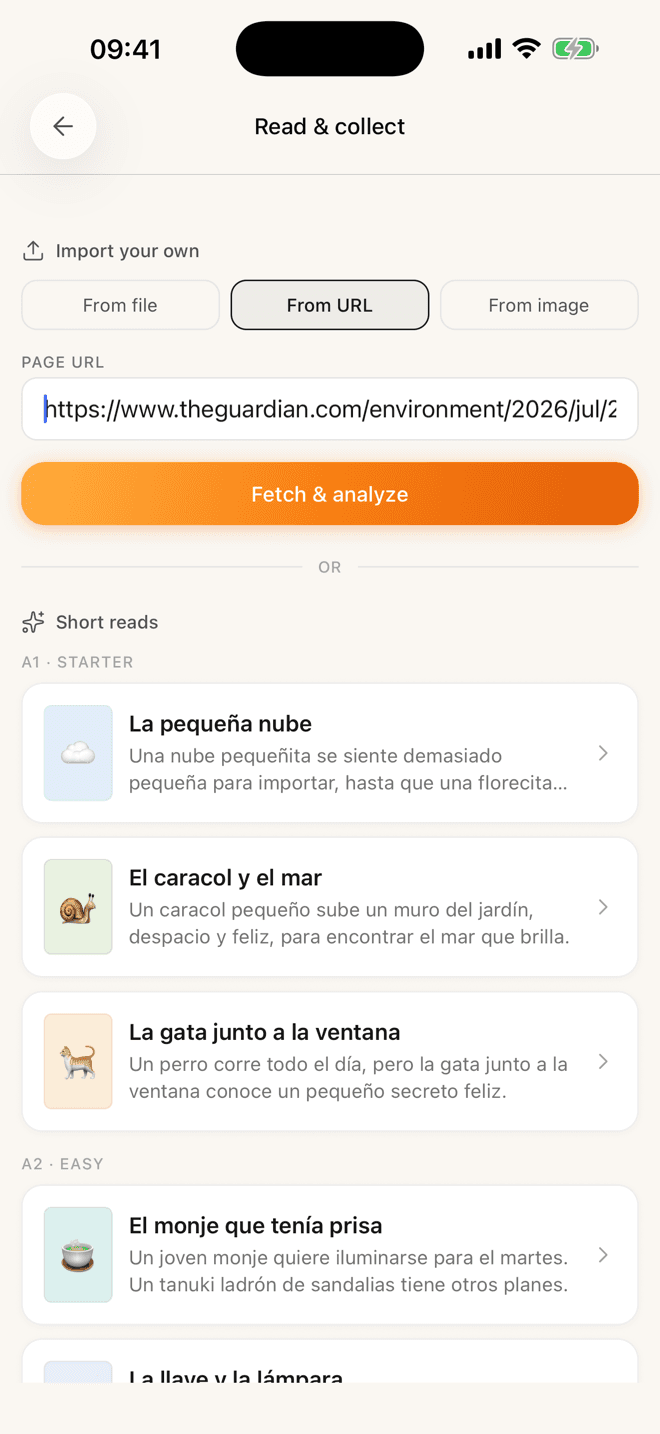
What “pull it into a reader” looks like in practice: paste the link, the server fetches the page and strips everything that is not the article, and it opens as clean text.
The four problems you will actually hit
Everything above is the happy path. Here is what goes wrong, in descending order of how often it has happened to me.
Paywalls. The most common failure by a distance. A fetcher gets the same thing an anonymous browser gets, so a hard paywall returns you a headline and a subscribe button. Nothing clever to be done about this: either subscribe to one outlet in your target language — which is a genuinely good investment if you are reading daily — or stick to outlets that are open. Public broadcasters are usually the most generous.
Wrong-language pages. Big international sites often serve you a localised edition based on where you are. If you are learning Spanish from Berlin you may get the German edition of the same story without noticing. Check the URL for a language segment before you paste.
Liveblogs and galleries. Anything that is really a stream of fragments rather than prose extracts badly, because there is no article in there to find. Skip them; they are poor reading practice anyway since the sentences never develop.
Comment sections. Occasionally the extractor grabs some. This is not the disaster it appears — comment prose is often closer to how people actually speak than the article is — but it will be full of slang and typos, and neither belongs in your review queue.
How many words should you actually save?
My rule, arrived at after two rounds of drowning myself: no more than about ten words per article. Not because ten is magic, but because the alternative has no ceiling and a review queue with no ceiling is a queue you eventually abandon.
If an article gives you thirty candidates, that article was too hard for the purpose. Read it anyway if you are enjoying it — comprehension practice is fine — but pick a different one tomorrow.
The words worth keeping are the ones you can imagine meeting again in the next month. Presupuesto yes. Retroexcavadora, which I genuinely once added, no.
Six minutes a day for a year is about three hundred articles. Nobody finishes three hundred novels.
The part that turns it into learning
Everything above gets you comprehensible input, which is most of the value. But the difference between reading an article and learning from one is what happens to the words afterwards.
This was my own failure mode for about a year. I read a great deal of Spanish news, understood nearly all of it, felt fluent, and could not produce any of the vocabulary a week later. I had been getting the pleasure without the ratchet.
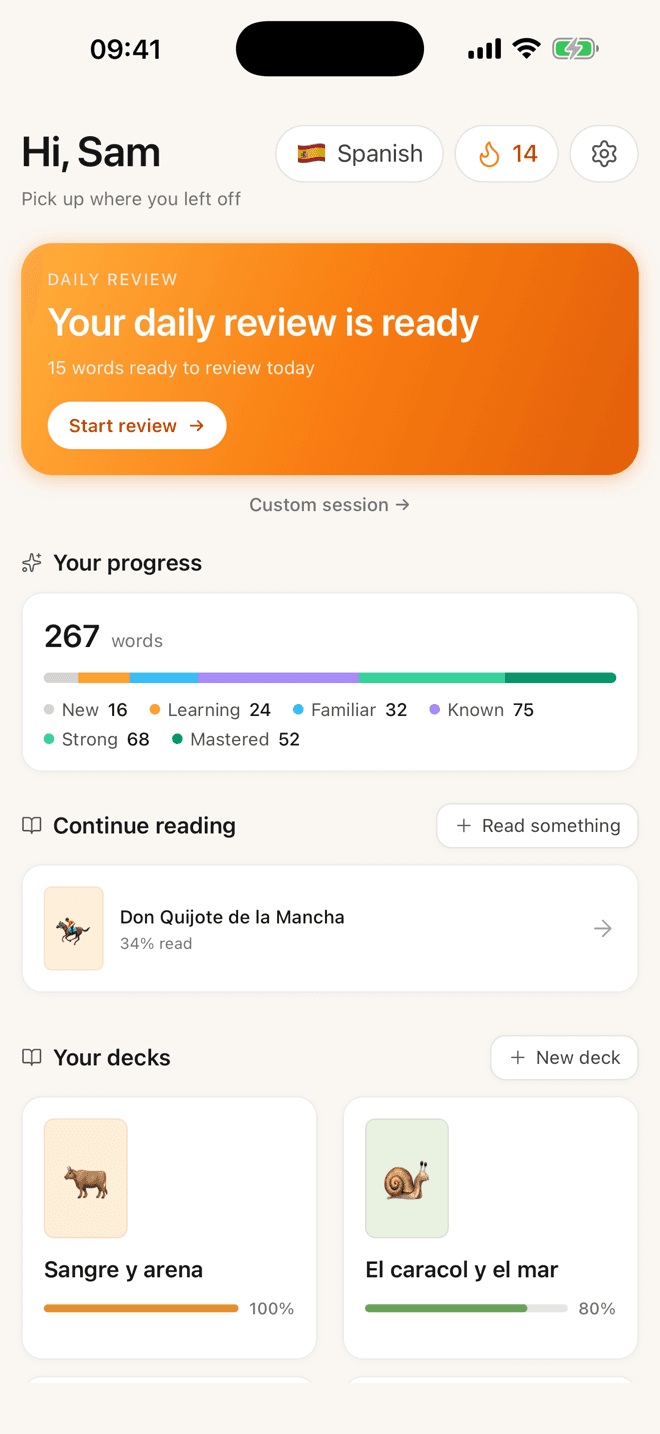
The fix is not more effort while reading. It is that the words you tapped have to come back to you, spaced out, without you having to organise it. In Lemnly that is what tapping a word does — the translation appears, you add it, and it lands in an FSRS queue that decides on its own when to show it to you again.
I think the “read the news in your target language” advice gets repeated so mechanically that people take the wrong version of it and go straight to the front page of a serious newspaper, which is close to the hardest prose that language produces daily.
Front pages are written for people with thirty years of context in that country. Go to the culture section. Go to sport. There is no prize for reading the difficult part of the paper, and there is a real cost to concluding you are worse at this than you are.
Where to find articles you will finish
- The culture or lifestyle section of any mainstream outlet in your target language. Not the front page.
- Sport, if you follow any. Match reports are the most reliably comprehensible journalism in any language, because you already know the shape of the story.
- Wikipedia articles on things you know well. Not journalism, but the same effect: familiar content, unfamiliar words, and a plain register.
- Whatever your friends send you. Genuinely. Interest beats level almost every time, and an article you actually want to read will pull you through vocabulary that a “level-appropriate” text never would.
The honest limitation
News vocabulary skews to news. Read nothing but politics and you will end up able to discuss a coalition negotiation and unable to describe your own kitchen.
So mix it. Articles for volume and currency, a novel for the domestic and emotional vocabulary journalism never uses, and conversation for everything neither of them covers. Articles are the easiest habit to keep, which is why they are the right place to start — not the right place to stop.
On picking that novel when you are ready, see how to choose a first book.
Questions people ask about this
- What level do I need before reading real news?
- A solid A2 is enough if you pick carefully — sport, culture, human interest. At B1 most of a mainstream outlet opens up apart from politics and economics. Below A2, graded readers will serve you far better, because at that level a news article is not comprehensible input, it is a puzzle.
- Should I read the same story in my own language first?
- It helps a lot and there is no shame in it. Knowing what happened means the unfamiliar words cost you very little, which is the same trick as reading a novel you already know. International stories are ideal for this because you can find both versions easily.
- Is it better to read one article carefully or three quickly?
- Three quickly, at this stage. Volume of comprehensible input is what moves you, and rereading a single article extracts diminishing returns fast. Careful reading becomes worth it later, when you are studying style rather than acquiring words.
- How long until this shows results?
- Give it a month before judging. The first two weeks feel like nothing is happening because coverage improves as a threshold rather than smoothly. Somewhere around week four you notice you are tapping fewer words per article, which is the signal you are looking for.
- Do I need a special app, or is a browser enough?
- A browser plus a dictionary works, and plenty of people learn that way. What a browser will not do is bring the words back to you afterwards, so if you go that route, pair it with something that schedules review — otherwise you are getting the reading practice and losing the vocabulary.